Showing posts with label spinning. Show all posts

Monday, July 6, 2015

Starting out

Shortly after taking a spinning class with Judith McKenzie, I decided it was time to spin, dye and knit a sweater.

I'd always taken a much looser approach before to spinning smaller quantities, aiming for general weights and not worrying too much about the details. I'd often not have a specific project in mind when spinning a braid or two. I'd just think "Hat", "mitts", "cowl" based on how much fiber I had or the colors.

Once I decided to spin a sweater quantity of fingering-to-sport weight yarn, I also came to the decision that I would do this 'properly'. I put properly in quotes because I decided this was the correct way for me to do it for the results I want. That's one of the beauties of spinning your own yarn - you get to decide what kind of yarn and final project is right for you.

My goals are to spin a 3 ply yarn that is approximately fingering or sport weight once all is said and done. I want it to look as even as possible, i.e., as close to commercial yarn as I can get it. To me, and for this project, that is my challenge: to spin and ply consistent singles to get a uniform yarn over the approximately 2,000 yards I'll need.

I'm keeping track of my progress and details using Ravelry's handspun page feature. To get consistent results I'll need to be diligent about tracking things like ratios used, wpi (wraps per inch), and even, yes, doing test yarns and sample swatches. When I'm on my 4th or 5th bobbin of singles, I want to know I'm using the same whorl and spinning the single to the same wpi as I did for bobbins 1-4.

I was eager to get started. As with most projects, I wanted to start and finish it right! away! And see results!

But I reined myself in and committed to spinning and plying a test amount first. After all, why fill a whole bobbin (or more) full of singles without knowing if I was getting the results I needed?

So, I spun what turned out to be 31g of singles at approximately 40 wpi. (Did I mention I bought a scale that measures down to .1g so I could get really detailed measurements?) Then, I split that as evenly as I could among three weaving bobbins - that's where the really accurate scale comes into play. One of my Maryland Sheep & Wool Festival purchases had been a bobbin winder, allowing me to easily wind singles off my Lendrum bobbins and onto the smaller, plastic weaving bobbins.

With the singles evenly distributed, I switched from my fast flyer (12:1 whorl) to the regular flyer and used the smallest whorl (10:1). This was among the suggestions given by Judith McKenzie in her spinning class - to use a whorl 1 bigger for plying than you had for spinning the singles. You want your singles to have lots of twist and ply them with slightly less (removing some of the twist). I'm paraphrasing and hopefully not distorting the message too much.

I plied the 3 singles until I ran out on the first bobbin. Happily, there wasn't too much of the singles left of the other bobbins. I'll use the leftovers later.

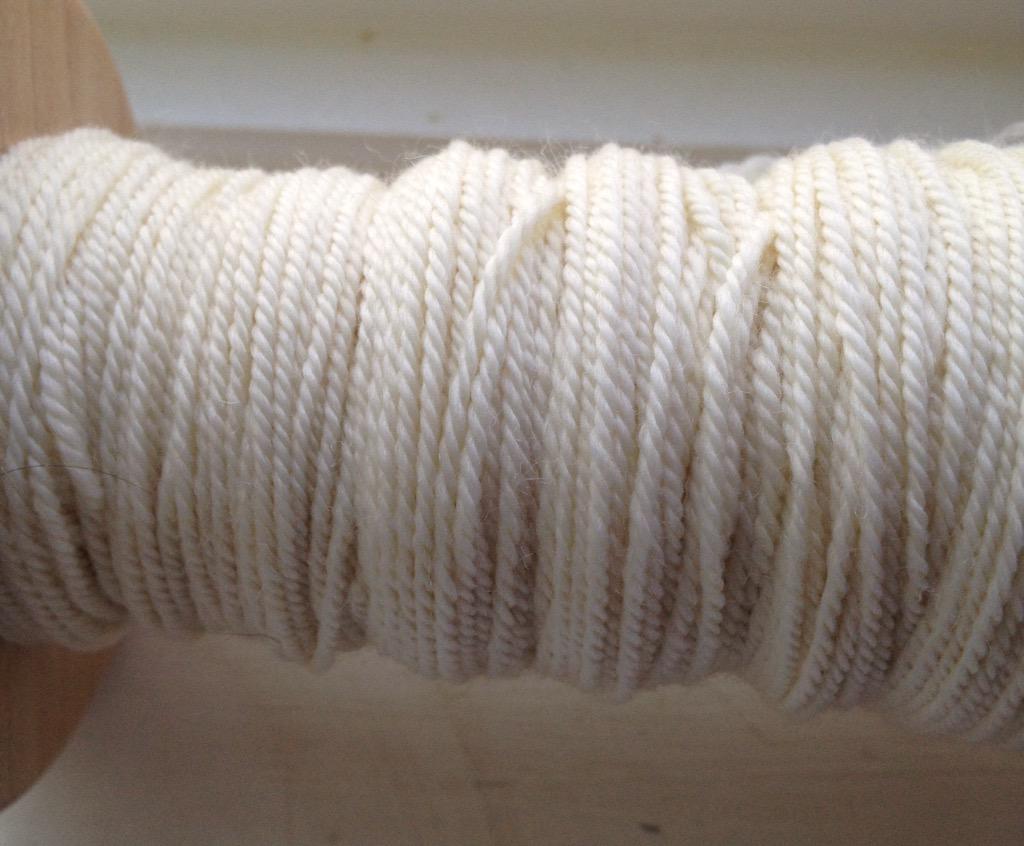
I have to admit, the 3 ply looked pretty darn fantastic on the bobbin. I let it sit for a day or two, as general wisdom recommends. Then I let it soak in cold water with some Soak and gave it a rinse. I always give my plied yarn a good whacking to even out the twist. Generally, I hold the skein and whack it (overhand) 3 times against the side of the tub, give the skein a quarter turn and whack some more, until I've given the skein a full turn. Then I hang it to dry, unweighted.
3 ply, on the bobbin.

I ended up with approximately 67 yards of 3 ply yarn that was approximately 18 wpi, which according to Ravelry is close to fingering weight.

What I did next was even more against nature than spinning and plying only 30g of fiber. I swatched.  But that's a tale I'll tell next time.


Wednesday, July 1, 2015

Into The Great Big Blue

I've had this Spirit Trail Fiberworks fiber since 2011, my first year at Rhinebeck. I don't recall having a plan when I snapped up the braids, but when I took stock last year, I had 4 braids of Polwarth/Silk, a braid of Merino/Cashmere and a 100% Superwash BFL all in similar shades of blue. That's 24 oz of fiber!
Lighter Merino/Cashmere single in this skein.

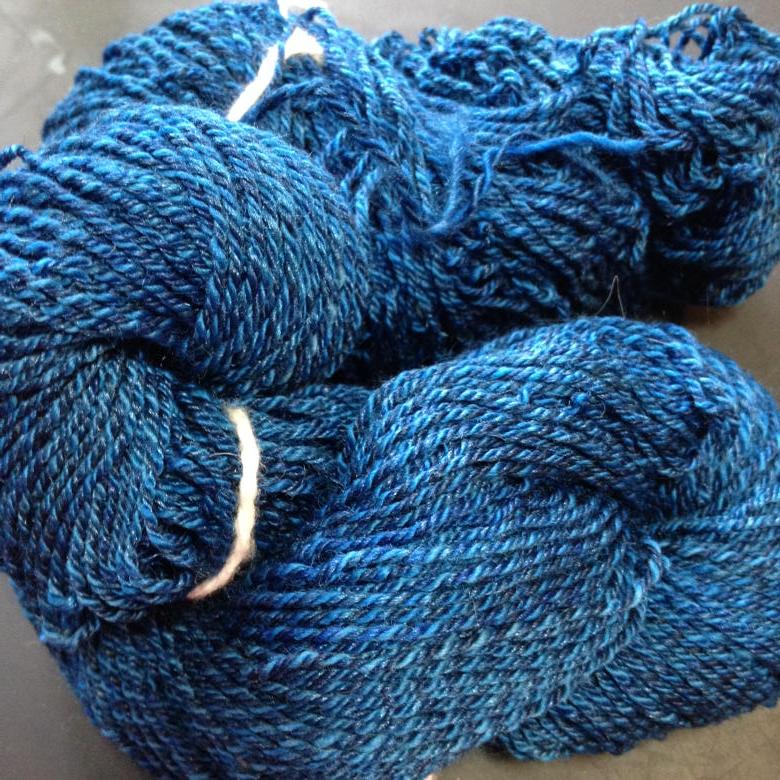
I began spinning it up last year but then life got in the way. I picked it up again in May and finished spinning all the singles, then began to 3 ply them. To balance out the slightly different colors (the cashmere blend was considerably lighter), I decided to ply 2 strands of the Polwarth Silk with the Cashmere blend, then 2 strands of the Polwarth Silk with the BFL. When I knit it up, I can alternate skeins to even out the color.


Jumbo skein
I started plying on my regular Lendrum flyer and soon filled up a bobbin that way. Then, I decided to try out a tip I'd garnered from Ravelry to make plying with the Lendrum Jumbo Head easier. And it worked (more on that in another post). So I finished plying on the Jumbo Head, which resulted in a 797yd, 13+oz skein!

After plying up the remaining singles, I ended up with a grand total of 1226 yards of 3 plied yarn. That should be enough for a lacey cardigan.


Tuesday, June 23, 2015

An Ambitious Project

I've been on a bit of a spinning kick ever since returning from Maryland Sheep and Wool in May. Where, among other things, I got it into my head to spin the yarn for a sweater of my own design.

Since then, I've somehow accumulated about 5 sweaters worth of fiber to spin. Along with spinning up (or finishing the spinning on) a bunch of fiber from previous festivals.

With that in mind, I thought people might be interested in following along in my journey to spin, dye and knit a sweater in several different kinds of fibers. This will be a long journey for sure. After all, I do have a day job in addition to a family. But I know I'm always looking for stories of what others have done, when I start a new-to-me technique. So maybe this will help someone in the future. (If only in a don't-do-it-it's-crazy kind of way!)

So, what's on my to-spin list?

  • 1 lb of lovely Merino/Rambouillet from Roclan's, purchased at MDSW 2015 (supplemented with 1 lb of Rambouillet from The Homestead Hobbyist on Etsy
  • 6 lbs of Merino/nylon roving from The Black Lamb, a local(ish) yarn shop
  • 3 lbs of Merino/cashmere/silk roving from The Black Lamb
  • 3 lbs of Merino/cashmere/nylon roving from The Black Lamb
  • 1.5 lbs of misc. fibers from Spirit Trail Fiberworks 
I'm not a monogamous spinner, so I'll likely switch between fibers somewhat to give myself the occasional change of pace.

Here's a sneak peak of some of my early results:
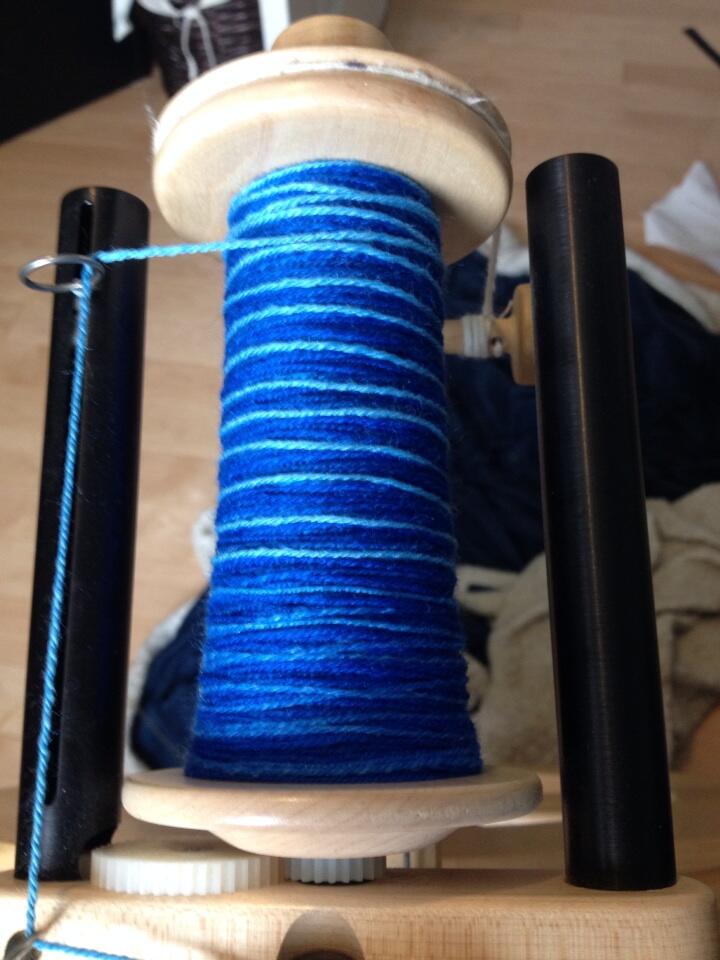
merino/nylon 3 ply

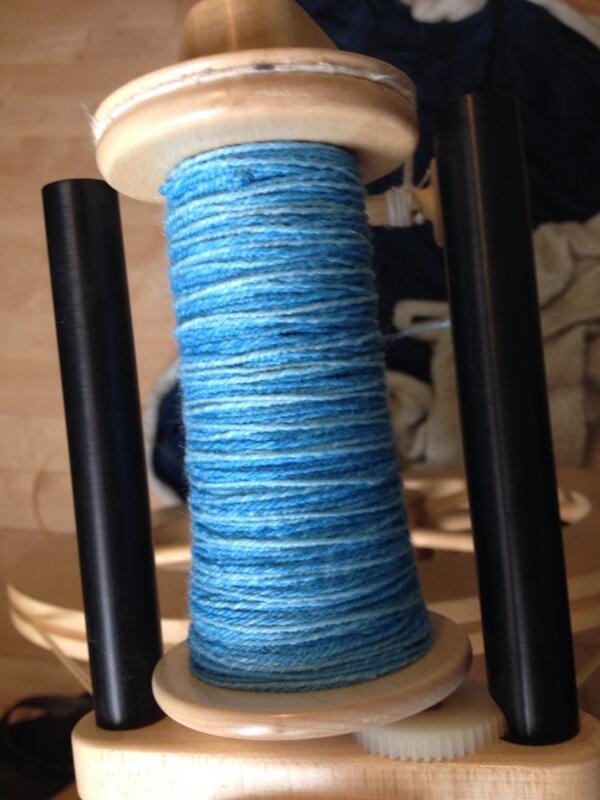
Spirit Trail Fiberworks 3 ply


Saturday, November 8, 2014

Maple Leaf Forever

(c) Natalia @ Elfmoda Maple Leaf Shawl
Last December Natalia @ Elfmoda released a stunning maple leaf shawl design. As a Canadian, I was entranced with the pattern, seeing as the maple leaf features prominently on our national flag.

I didn't really place the shawl high on my 'to knit' list until a chance remark by a friend at Rhinebeck. Rhinebeck is a cornucopia of beautiful shawls, yet my friend noted that no one seemed to have knit the Maple Leaf shawl as their Rhinebeck signature piece. "Maybe next year", she said.

That's when I got the idea to knit one for Rhinebeck next year. Later in the day, I happened to find a braid of Polwarth fiber in the perfect Fall colors. I snapped it up, with the idea to spin the fiber and knit the Maple Leaf shawl with it. I pictured a shawl that mimicked how real leaves turn from green to yellow to red. I had no idea about yardage, but I figured one 4 oz braid should be enough, even if I had to use singles or at most, 2 ply yarn.

After browsing the Ravelry project notes of finished shawls, I decided to take a chance and spin the fiber with a view to navajo plying it to preserve the color transitions. I'd recently spun a skein of 440ish yards of 3 ply out of a braid. And many of the project notes stated that they'd only used between 400 and 450 yards on smaller needles than the pattern called for.

So, I spun. And spun. And spun. It took about 2 weeks to spin and then ply the yarn. I was so eager to get it done so I could start knitting the shawl and see if it would turn out the way I envisioned it. (And frankly, if I'd have enough yarn!)


Once I got started on the shawl, it sped along quickly. The pattern is a clever collection of simple knit stitches, yarn overs and decreases. The color transitions are nicely preserved as you knit the main body of the leaf and then separately knit each point of the leaf. I started getting anxious about how much yarn I had left by the time I started working on the final (and center) three points of the leaf. And when I got down to the second last leaf I was down right nervous.

My ball of yarn was getting smaller and smaller. There are several small points, each of which require you to break the yarn and then join again to the main body. All that breaking of yarn and rejoining meant several inches of yarn getting 'lost' each time.

Finally, this morning I finished the shawl, with about 4 grams of yarn to spare! Whew! The shawl is blocking now. It's smaller than the pattern calls for, since I used smaller needles to ensure I didn't run out of yarn. But it's lovely! Just what I'd envisioned.

I'm hoping to find a way to display it as a piece of wall art. The trick will be keeping all those points in place!

Friday, October 31, 2014

Catching Up

Whew! Summer is long gone and here we are on All Hallows Eve.

A lot has happened in the months since I last posted. Some of it bad, some of it good. All of it busy. I'll be posting more and catching up on things in the coming days and weeks.

In the mean time, here's a little something I began early in the summer and finished up the other week. It languished for quite a while in between, but I finally finished plying it!

I'm rather pleased with how it turned out.

Lorna's Lace merino/nylon 100g
Separated into 4 colors and navajo plied to maintain the colors.
Approximately 425 yards of 3 ply.


Monday, June 2, 2014

A Miracle!

Surely a sign of the upcoming apocalypse or, on a more positive note, a miracle of some sort. I've actually spun and plied some roving in the same month in which I purchased it!

Navajo plying: color transition
Back at the beginning of May, I went to Maryland Sheep and Wool and battled the crowded Fiber Optic Yarns booth to pick up some merino/silk blend gradient roving. I selected a lovely blue gradient, going from a very light sky blue progressing to a midnight blue-black. A stunning red to black gradient also leaped into my bag.

A weeks ago, I started spinning the blue gradient. After a couple of color changes, I got smart and worked out a system for managing the color transitions. I tried to break the braid apart into 12-18" pieces in a spot where the colors changed. Then, after separating out the larger piece of roving into smaller, more manageable strips, I began spinning the tips of each strip where the already spun color was. When I hit the next color, I stopped and went to the next strip of roving. That gave me a nicer color transition.

I was focused on spinning fine singles, but not cobweb thin. I wanted to end up at a decent fingering-ish weight yarn after plying. I'd already decided to Navajo ply to maintain the color transitions. I'm not a big fan of barber-poling handspun. I also focused on not including a lot of twist in my singles. Previously, I've tended to over-twist my singles resulting in those little pigtailing sections. Consistency was my watch word.

In what felt like record time, I was ready to ply. In the past, I've had my singles snap on me at thin spots. This time, I was pleased to get through plying with only 1 breakage. Noticeable improvement is always encouraging!

Final transition to light blue.
I really enjoyed watching the color changes. I kept my treadling slow and steady and moved my hands deliberately, trying to keep the yarn plying in a consistent manner.

Surprisingly (or not), the plying took several hours which I managed with only 1 break to answer the door.

I really love my Woolee Winder for enabling me to focus on spinning instead of moving my yarn manually along the bobbin. The only 'issue' was that I didn't get to see the color transitions progress up the bobbin. Each color gets covered up by the new color. But I won't complain!

I decided to let the plied yarn rest on the bobbin for 24 hrs - more because I forgot to skein it before going to bed than due to any patience on my part.

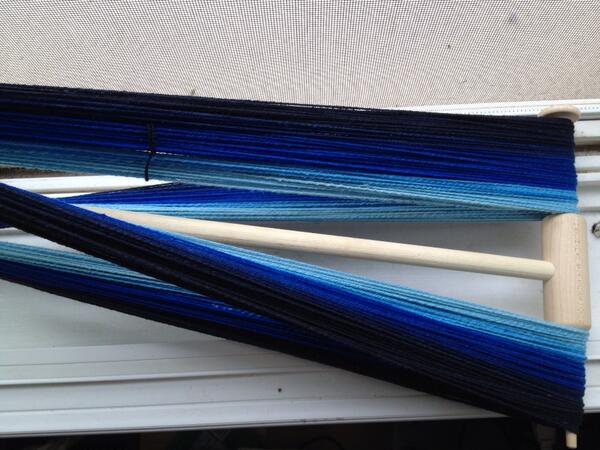
On Sunday I wound it onto my niddy noddy, valiantly attempted to keep track of how many times I wrapped it so I could estimate yardage.
On the niddy noddy, waiting for a bath

I'm pretty sure it's around 260 yards of 3 ply yarn. And doesn't it look darn pretty wound up like that?

I've also learned to not wind it so tightly on the niddy noddy. Makes it much easier to remove the yarn.


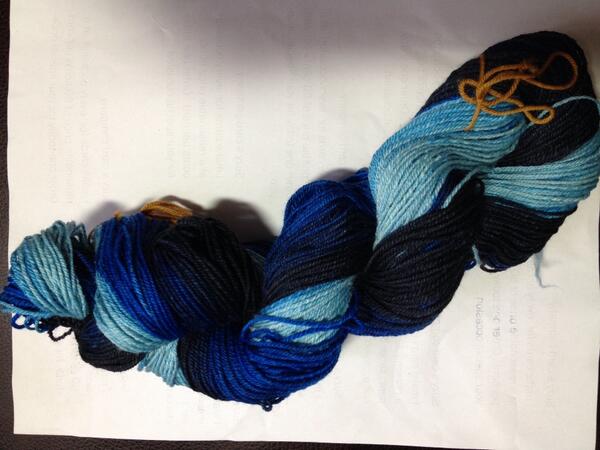
Here it is, waiting for its bath:


I'm extremely proud of this skein. It turned out very well balanced, with very few pig tail corkscrews. I think it needs to be a shawl.

I'm looking forward to spinning up my other Fiber Optic braid and seeing the red to black transition.